Young people are increasingly invited to participate in civic life through digital spaces connected to schools, youth organizations, and public institutions. Yet many of these experiences fail to build trust: they feel complex, unsafe, or disconnected from real-world impact.
At the same time, most online spaces where societal issues are discussed are commercial platforms, not designed for learning, legitimacy, or long-term stewardship. The challenge is to understand how digital public spaces can support meaningful, trustworthy participation for young people: Across both digital and physical civic life.
Senior service design (self-initiated project)
I framed the challenge, synthesized research, mapped the service ecosystem and participation journey, and translated insights into design principles and opportunity spaces. The work draws on my background in UX research and cognitive science.
This project examines how young Europeans (16–25) encounter and participate in civic processes through digital public spaces, focusing on how design of structure, governance, and interaction influences trust, understanding, and willingness to participate.

The experience gap:
why trust breaks down
Across Europe, digital entry points to civic life have multiplied, yet young people often find themselves navigating complex, fragmented, and hostile experiences that undermine trust, discourage exploration, and make meaningful participation feel out of reach.
Participation frequently requires decoding institutional language, overcoming psychological risk, and working through unclear processes - conditions that can diminish, rather than foster, confidence and engagement.
This case study explores how the design of digital public spaces influences comprehension, psychological safety, and perceived impact.
A system in motion: mapping the civic participation landscape
This map illustrates how youth civic participation emerges from the interaction between young people, physical institutions, digital civic spaces, and public governance structures. Trust-related breakdowns often occur at the boundaries between these layers.
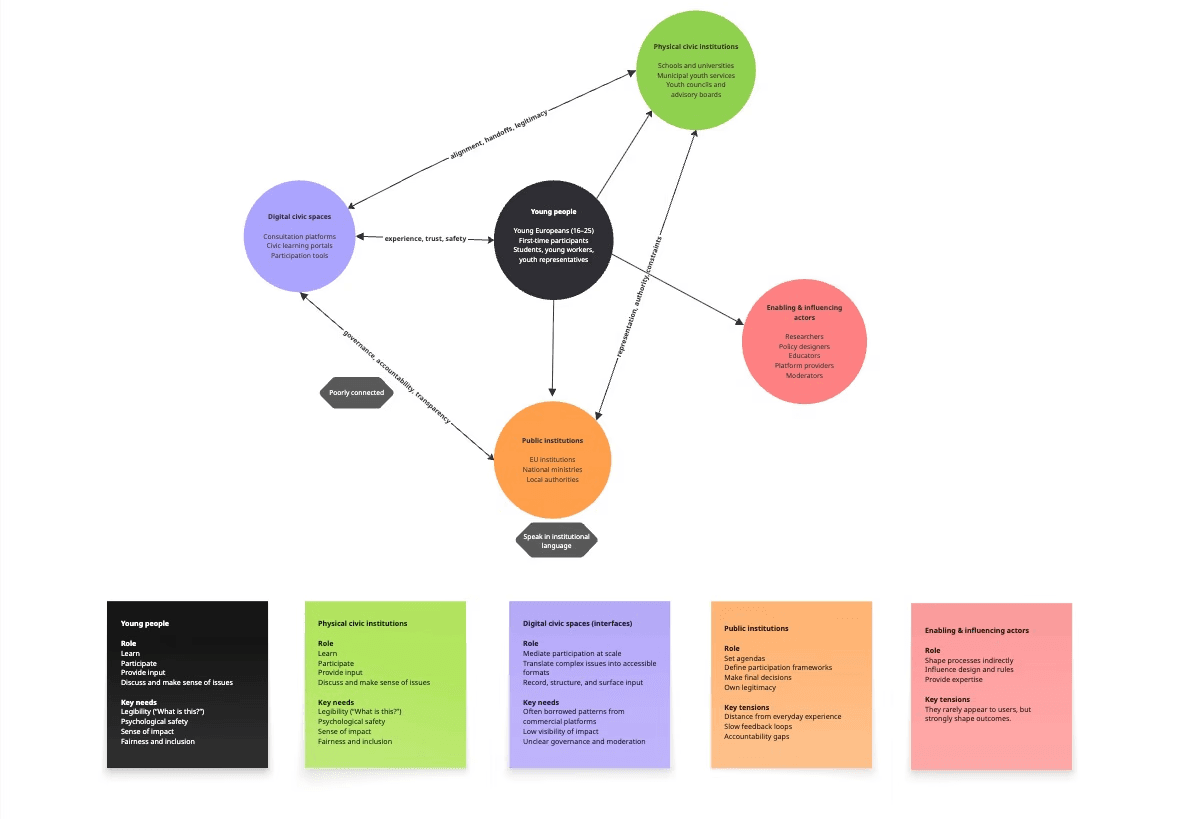
This map is not merely descriptive. It reveals the invisible interfaces where trust is most fragile - between young people and institutions, between digital access points and human support - and points to where design can change not only experience but meaning.
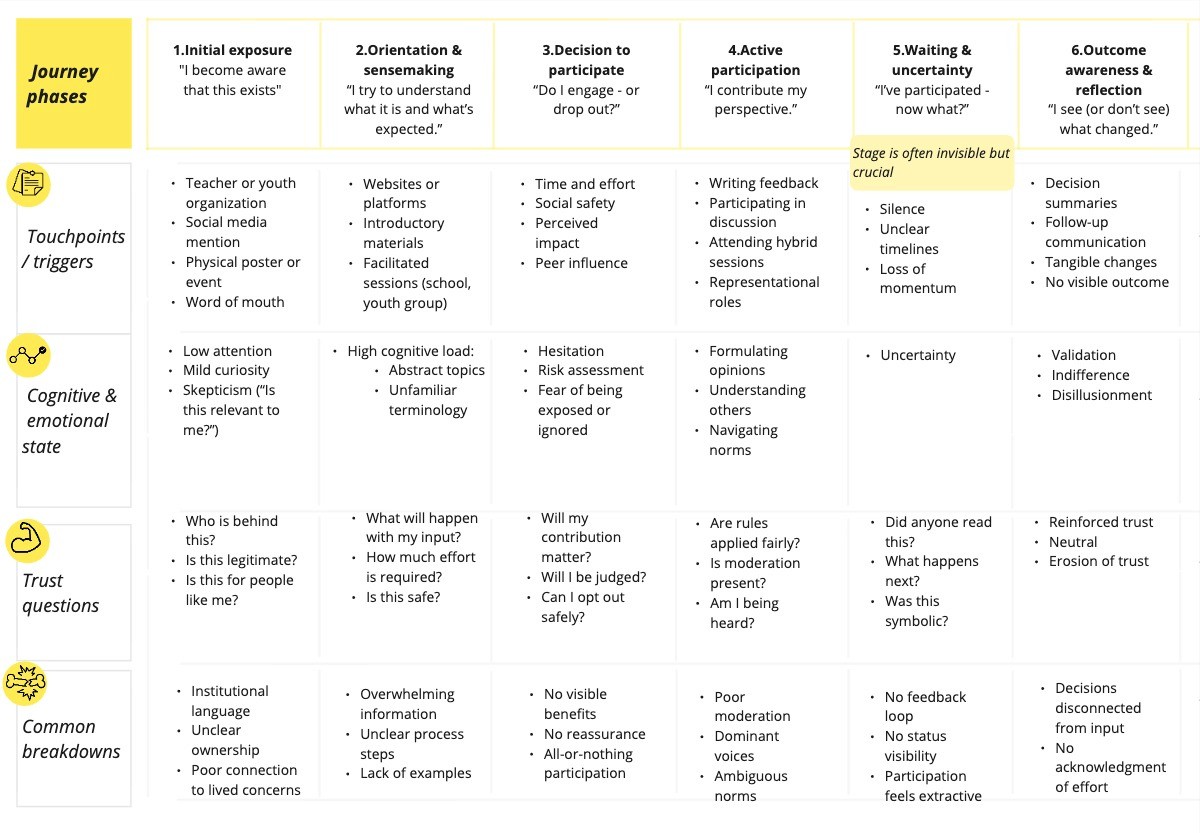
How young people experience participation: journey view
Youth civic participation in a hybrid digital–physical context. For many youth, the journey to participation feels like “signal without meaning”: clear entry points lead into opaque processes, and after contribution there is no visible trace of impact or progress.
The core tensions shaping trust in civic participation
Trust in civic participation is not created by single features or platforms. It emerges from ongoing tensions between institutional goals and young people’s lived experiences.
The following picked tensions highlight where participation often breaks down and where design has a role in making these dynamics more legible and humane.
What?: Institutions derive legitimacy from formal mandates and procedures.
Young people judge relevance through personal connection and lived experience.
Why?: When civic initiatives feel abstract or detached from everyday concerns, legitimacy alone is not enough to motivate participation. Young people may recognize institutional authority but still disengage emotionally.
Design implication
Legitimacy must be experienced, not assumed.
What?: Civic processes aim to be open, inclusive, and participatory.
Open participation increases exposure, judgment, and social risk.
Why?: If young people do not feel socially or psychologically safe, openness becomes a barrier rather than an invitation.
Design implication
Participation requires graduated entry, clear norms, and visible moderation - not just access.
What?: Civic issues are complex, multi-layered, and slow-moving.
Young people encounter them with limited time, context, and prior knowledge.
Why?: High cognitive load leads to confusion and self-doubt, which can be misinterpreted as disinterest or apathy.
Design implication
Design must support understanding without oversimplifying or patronizing.
From these structural tensions, we derive a set of design principles that do not prescribe solutions,
but illuminate how participation can feel more legible, safe, and impactful.
Make legitimacy
experiential,
not implicit
Legitimacy should be communicated through experience, not assumed through institutional authority.
Design participation as
a gradient, not a gate
Participation should offer multiple levels of engagement, allowing people to enter, observe, and contribute at their own pace.
Reduce cognitive
load without
reducing
complexity
Complex civic topics should be made understandable without being simplified or distorted.
Making participation legible, safe, and connected across digital and physical civic life
Across the participation journey, opportunities for design emerge around how young people first encounter civic processes, how safe and approachable participation feels, how clearly progress and outcomes are communicated over time, and how digital participation connects to physical civic life.
Designing these spaces is less about introducing new platforms and more about clarifying roles, expectations, and governance, making participation feel legible, supported, and meaningfully connected to real-world impact.
Reflections & Limitations
This project takes a research- and systems-led approach, prioritizing structural understanding over proposing a single solution.
While this allowed for a broader perspective on trust and participation across contexts, the work is primarily based on desk research and synthesis rather than direct engagement with young people.
Trust in civic participation also emerges over time and through lived experience, meaning the insights and principles identified here should be seen as guiding conditions rather than prescriptive answers.

Charlotte Kleckers
Copenhagen